TaskFlow: Kanban Task Manager with MEAN Stack and JWT Authentication
1 Oct, 2026
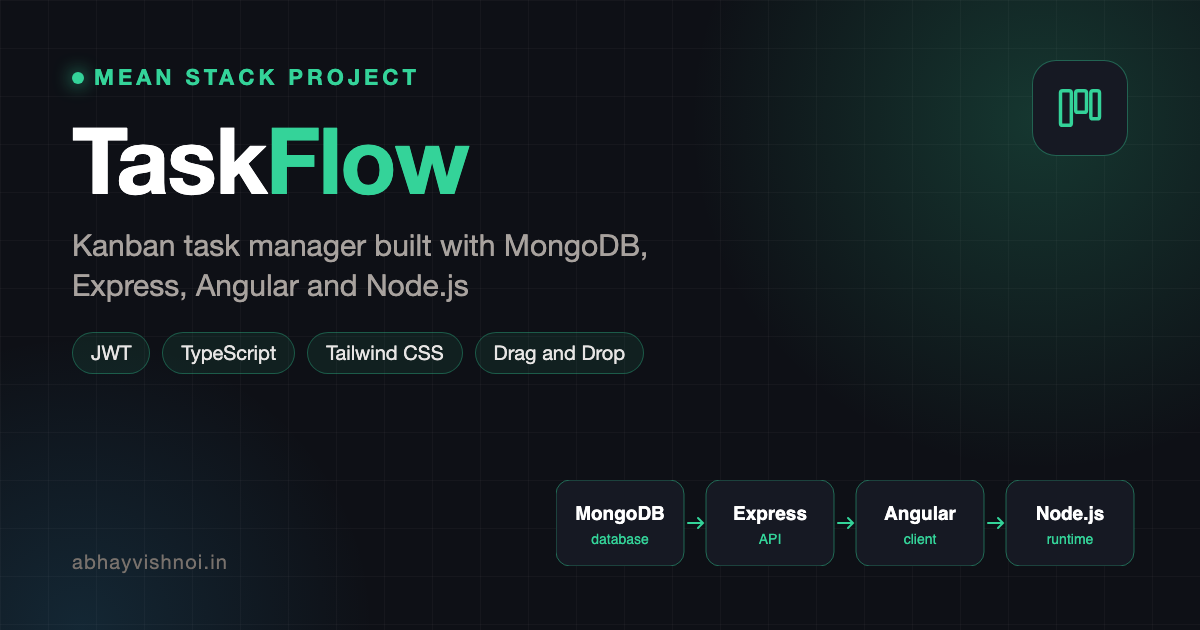
TaskFlow is a full-stack Kanban task manager built on the MEAN stack (MongoDB, Express.js, Angular and Node.js). It lets people organise work into boards, lists and cards, drag tasks between columns and keep everything private behind JWT authentication.
A complete, production-style MEAN stack example: secure authentication, a clean REST API, optimistic drag and drop and a responsive dark interface.
Key features
Boards, lists and cards
Create boards for each project, add lists such as To do, In progress and Done, and manage tasks as cards with titles, descriptions and due dates.
Drag and drop
Move cards between lists with the Angular CDK. The interface updates instantly and the new order is saved to MongoDB in the background.
JWT authentication
Sign up and log in with hashed passwords. Short-lived access tokens protect every API route and an HTTP interceptor attaches them automatically.
Labels, filters and search
Tag cards with colour labels and filter or search a board to find the right task in seconds.
Responsive dark UI
Built with Tailwind CSS so boards stay readable and usable on phones, tablets and wide desktop screens.
Validation everywhere
Input is validated in Angular forms and again on the server, so bad data never reaches the database.
How it works
- A user registers or logs in and the Express API returns a signed JWT.
- The Angular app stores the token and a route guard keeps private pages behind a login.
- Boards, lists and cards are loaded from REST endpoints backed by Mongoose models.
- Dragging a card updates the local state first, then sends a small PATCH request with the new list and position.
- The API checks ownership on every request, so users only ever see their own boards.
Architecture and design decisions
The project follows a clear separation between the Angular client and the Express API, which keeps each side easy to test and deploy on its own.
- Feature modules in Angular for auth, boards and shared components, loaded lazily to keep the first page fast.
- Mongoose schemas for users, boards and cards with indexes on the fields used by queries.
- Middleware for authentication, validation and centralised error handling in Express.
- Position ordering stored as numbers so reordering a card changes one document, not the whole list.
Tech stack
- MongoDBDatabase
- Express.jsAPI framework
- AngularFrontend
- Node.jsRuntime
- TypeScriptLanguage
- JWTAuthentication
- MongooseData modelling
- Tailwind CSSStyling
- Angular CDKUI toolkit
What this project demonstrates
TaskFlow shows how to design a secure, well structured MEAN stack application from the data model to the user interface: token-based authentication, ownership checks, an API contract the client can rely on and a smooth drag and drop experience.
Tags
Recent Posts
 9 Oct, 2026
 FinTrack: Expense Tracker and Analytics Dashboard on the MEAN Stack
FinTrack is a personal finance and expense tracking dashboard built with the…
 7 Oct, 2026
 InkSpace: Blog CMS with MEAN Stack and Angular Server-Side Rendering
InkSpace is a blogging platform and content management system built with the…
 5 Oct, 2026
 ShopSphere: MEAN Stack E-commerce Store with Stripe Payments
ShopSphere is a complete e-commerce store built with the MEAN stack. Shoppers…